Case Study
Global manufacturer saves $3M+ a year with Author-it CCMS

Summary:
A global consumer products manufacturer saves more than $3 million a year in translation costs with Author-it, a component content management system (CCMS). The manufacturer's $10 billion consumer division reuses 60-70% of its content across hundreds of products and 20-25 languages, translates each component once, and lifted its documentation satisfaction score from about 6 to 8 or above. Country-by-country compliance audits are faster and more accurate, with less waste, rework and paper, and customer care teams can respond consistently in every channel.
Results at a glance
- $3M+ saved a year in translation costs.
- Translation costs cut by up to 90%, because each component is translated once.
- 60-70% of content reused across products and markets.
- Documentation satisfaction score raised from about 6 to a minimum of 8.
- Faster, more accurate compliance audits in every country.
Customer profile: global consumer products manufacturer; $10 billion consumer division; personal care and household products; 25 writers and 5 linguists; 20-25 languages; hundreds of R&D stakeholders; Author-it customer since 2013.
Who is the customer?
The customer is the $10 billion consumer division of a global manufacturer that designs and sells personal care and household products, from oral care to shaving and grooming, in markets worldwide. The division's documentation team of 25 writers and 5 linguists supports hundreds of products, hundreds of R&D stakeholders and 20-25 languages.
The division's documentation includes user manuals, directions for use (DFUs), safety information and service content. Every product ships with documentation in the languages of the markets it is sold in, and every document is subject to country-level compliance rules. The case study is anonymised.
What was the challenge?
The manufacturer's challenge was keeping product content consistent, accurate and affordable across hundreds of products, regions and languages. Before Author-it, each region had its own way of writing and producing documentation, and customers noticed the difference. Five problems stood out:
- High localisation and translation costs, with unchanged text paid for again in every release.
- Content fragmented across print, web and product lifecycle management (PLM) systems.
- Compliance complexity and audit risk, country by country.
- Long lead times, with variable quality and a slow, change-heavy review process.
- The need for global consistency and synchronisation across hundreds of products.
Why did documentation quality matter so much?
Documentation quality mattered because the division could measure its effect on revenue. The division found a direct link between customer satisfaction with product manuals and overall customer satisfaction and market share. In personal grooming products, one percentage point of market share was worth about $108 million in global sales.
The division scores its documentation on an index from 0 to 10 that it calls its Net Promotability Score. The index covers brand promise, whether a reader would recommend the product, quality, consistency, safety, speed to read, how inviting and easy the document is to read, and how recognisable it is. Documentation that scores around 6 is low enough to damage the brand. Documentation that scores above 8 strengthens the brand and has a positive effect on revenue.
Why did cost matter just as much?
Cost mattered because consumer products compete on price. In the division's market, even a fraction of a cent off product cost helps a product compete, and if price drifts out of line with competing products, revenue falls. Translation, desktop publishing and rework costs were all under constant pressure.

Why did the manufacturer choose Author-it?
The manufacturer needed a scalable way to standardise content creation and delivery worldwide while reducing costs and improving compliance. Author-it met those needs with four capabilities:
- Component-based authoring that structures content for reuse, so one approved component serves every product and market that needs it.
- Single-source publishing for consistent output across print, web and other channels.
- Translation of new and changed content only, so each component is translated once and reused in every language.
- A cloud-ready architecture with minimal IT dependency.
How does the manufacturer use Author-it?
The manufacturer's 25 writers and 5 linguists author product content once, as reusable components, and publish the content to every market and language from one source. Author-it supports the company's global innovation centres and connects documentation with its PLM systems.
How did the team cut review and publishing effort?
The manufacturer set up a cross-functional documentation improvement team, working with Author-it, to analyse and improve how its directions for use are created, translated and published. The team's goal was to make the whole process 25% more efficient, and it set five objectives:
- Reduce the number of changes made while a document is being created.
- Increase standardisation and reuse, to shorten lead times, meet deadlines more reliably and reduce translation work and spend.
- Reduce the resources spent on review.
- Gain efficiency at publication.
- Improve the reliability and efficiency of the documentation system.
To cut desktop publishing costs, the team moved as much formatting as possible into Author-it's publishing engine and output templates, limited the number of layouts in use, and finalised layout only once all content and translations had been reviewed and approved. Manual layout correction now happens once, at the end, instead of in every language and every review round.
How does translation work?
Translation at the manufacturer runs through one process for every language. Author-it sends only new and changed components to translation, and the manufacturer's language service provider connects directly to Author-it, so translation jobs move between the two systems automatically instead of by email and file transfer. The provider also upgraded the manufacturer's translation memories to match Author-it content more closely, which raised the share of text that does not need to be translated again.
Who works with the content?
Content managed in Author-it reaches well beyond the writing team. Functional engineers, content reviewers, project managers, marketing communicators, global innovation teams, and FDA and other national compliance officers all use or rely on the same approved components.
Consistent, single-source content also prepares the manufacturer's customer care teams. When an issue spreads on social media, a consistent global response through self-help content and call centres can calm a difficult situation. That response has to be well written, fast and identical in every channel, which is only practical when every channel draws on the same approved source.
"Consistency across global teams used to feel impossible. Every region had its own way of doing things, and that created confusion for customers. With Author-it, we finally have one source of truth: content that's accurate, clear, and ready for every market. It's changed the way we work and strengthened our brand."
CCMS Expert, Global Manufacturing Company

What results did the manufacturer achieve?
The manufacturer saves more than $3 million a year, mainly in translation, and reports gains in quality, compliance and customer satisfaction.
- $3M+ saved a year: content is translated once, cutting translation costs by up to 90%. The saving exceeded the company's expectations.
- 60-70% content reuse: most content is written once and reused across products and markets, which lowers cost and helps products compete on price.
- Documentation satisfaction from about 6 to a minimum of 8: scores that consistently came in at or near 6 rose to 8 or above after the move to Author-it, moving documentation from a brand risk to a brand asset.
- Audit readiness: country-by-country compliance audits are faster and more accurate, and the company can show continuous, complete readiness while cutting waste, rework and paper.
- Consistent customer care: self-help content, call centre answers and service updates match across paper, electronic and web channels, wherever the customer is, including in the customer's home.
The company also reports increased customer satisfaction and market share, and a positive impact on hundreds of people across the organisation.
“Keeping costs down was critical. With Author-it, we cut translation costs by 90% and saved over $3 million a year, while reusing up to 70% of our content. That kind of efficiency makes a real difference.” CCMS expert, global consumer products manufacturer
What can other manufacturers learn from this?
The lessons from this case study apply to manufacturers of any size, because they come from how product content behaves, not from the size of the team.
- Find the repeats first. The manufacturer's savings came from content that appeared in many documents: warnings, specifications, procedures and boilerplate. A small team with a family of similar products has the same pattern on a smaller scale.
- Translate components, not documents. Sending only new and changed components to translation is what turned reuse into a $3 million saving. The effect starts with the second language and grows with every language added.
- Fix layout at the end. Finalising layout once, after content and translations are approved, removes a cost that otherwise repeats in every language.
- Measure quality as well as cost. A documentation satisfaction score gave the manufacturer proof that better documentation protects revenue, not only that it costs less.
What's next?
Structured, single-source content is also what AI systems need to answer accurately. Author-it customers can publish the same approved components as AION structured JSON for AI assistants and retrieval-augmented generation (RAG) pipelines, on cloud and on-premise deployments, and Author-it Cloud customers can connect Claude to their library through Author-it MCP from 2026.R4. See how Author-it supports manufacturing documentation, read what a CCMS is, or estimate your own savings with the ROI calculator.
Manufacturing case study FAQ
Q: How did the manufacturer save $3M a year with Author-it?
A: The manufacturer saves more than $3 million a year, mainly in translation. Author-it stores content as reusable components, so each component is translated once and reused wherever it appears, cutting translation costs by up to 90% across 20-25 languages.
Q: How much content does the manufacturer reuse?
A: The manufacturer reuses 60-70% of its content. Writers create each component once and reuse the component across hundreds of products and markets, instead of copying and maintaining separate versions.
Q: Did documentation quality improve after the move to Author-it?
A: Yes. The manufacturer scores its documentation on an index from 0 to 10 that covers quality, consistency, safety and readability. Scores that sat at or near 6 rose to a minimum of 8 after the move to Author-it.
Q: How did the manufacturer reduce desktop publishing costs?
A: The manufacturer moved formatting into Author-it's publishing engine and output templates, limited the number of layouts in use, and finalised layout only after all content and translations were approved. Manual layout work now happens once, at the end, instead of in every language and review round.
Q: How does Author-it help the manufacturer with compliance audits?
A: Author-it keeps one approved source for each component, with version history, so the manufacturer can show complete, current documentation in country-by-country compliance audits. Audits became faster and more accurate, with less waste, rework and paper.
Q: Who works with Author-it content at the manufacturer?
A: A team of 25 writers and 5 linguists authors the content. Functional engineers, reviewers, project managers, marketing communicators, innovation teams and compliance officers, including those who work with the FDA, also use or rely on content managed in Author-it.
Q: Do these results apply to smaller manufacturers?
A: The savings scale with how much content repeats and how many languages you translate into, not with team size. A smaller manufacturer with a family of similar products sees the same pattern on a smaller scale: shared warnings, specifications and procedures written once, and only new or changed content sent to translation.
Published on:
Author:
October 7, 2025
Quinn Wright
Head of Sales
Related Resources
Webinar
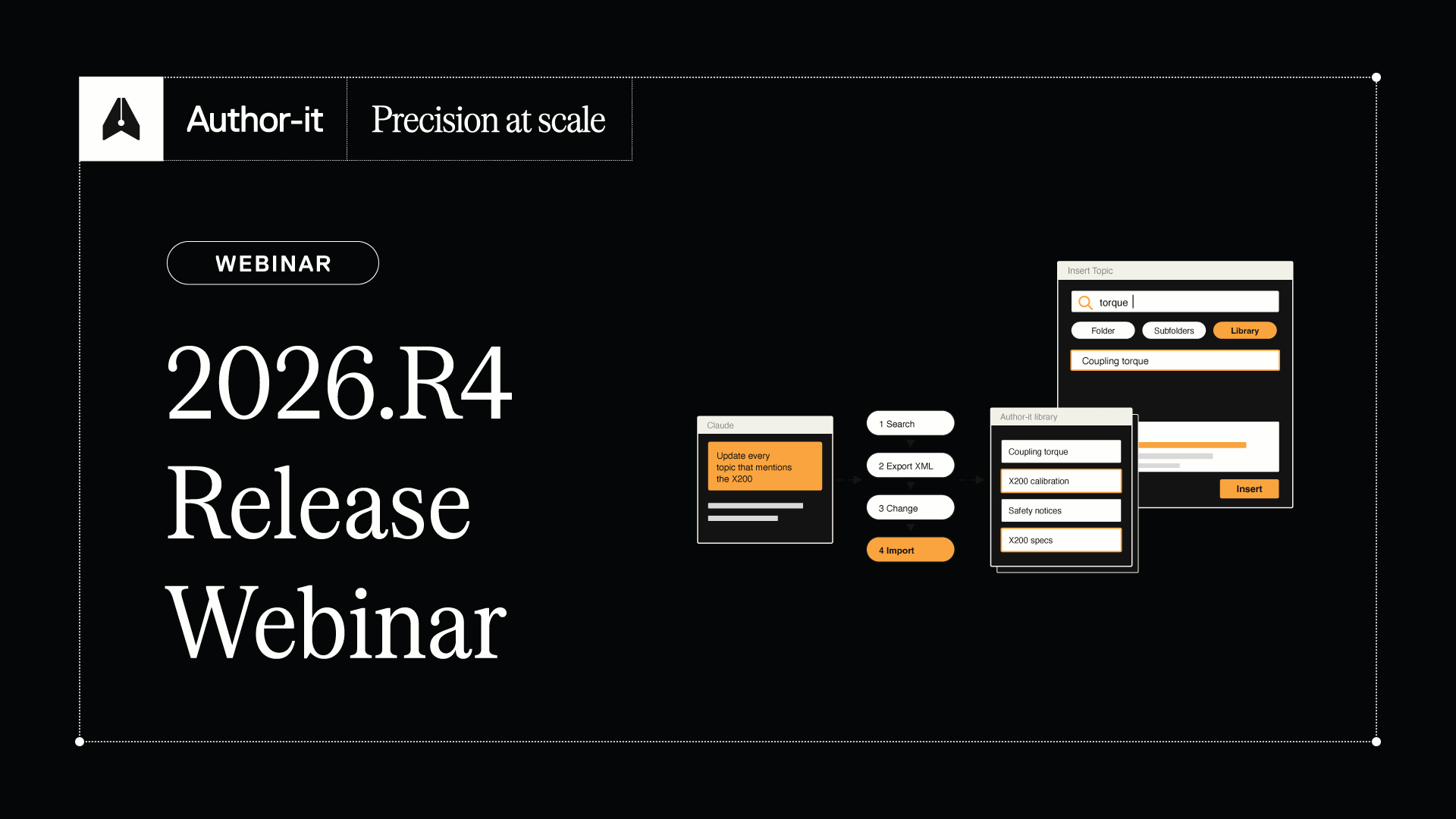
Author-it 2026.R4 Release Webinar - Register
Join the 2026.R4 release webinar to see Claude working in Author-it Cloud, the new Search and Insert window, Markdown publishing and the R4 dates.
Webinar
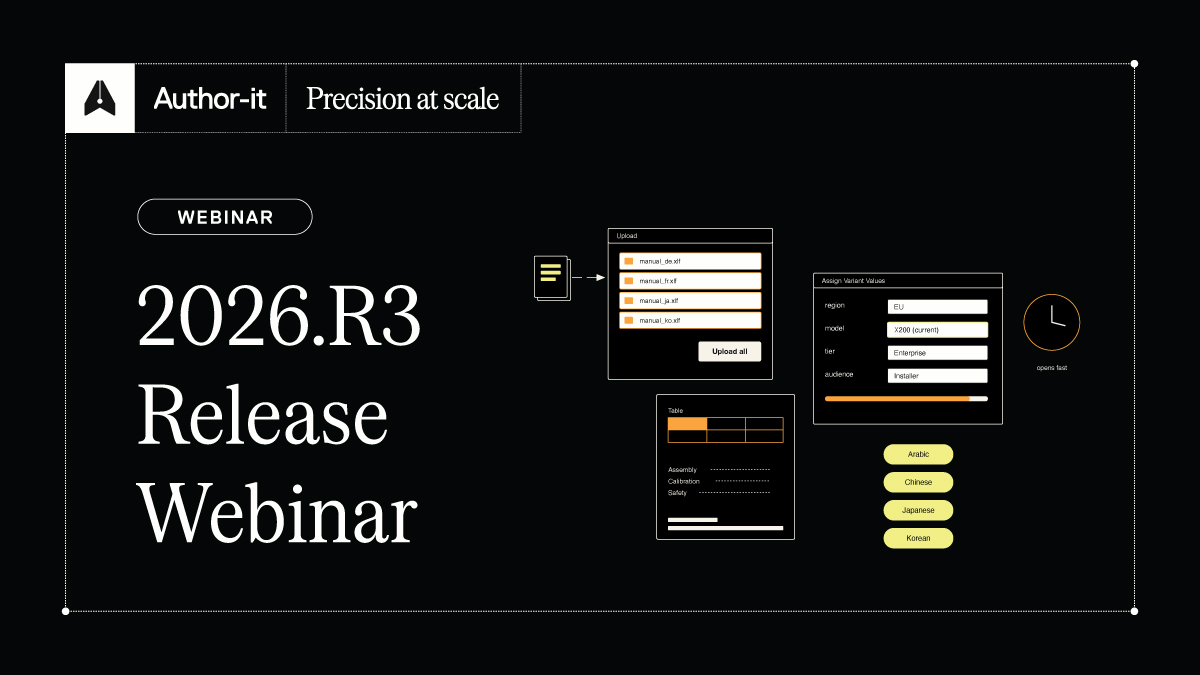
Author-it 2026.R3 Release Webinar - What's New
The full Author-it 2026.R3 release webinar recording, with the biggest New Word update yet, richer AION output, and the R3 go-live dates.

Article
Content lock-in: the exit tax nobody budgets for
The cost of leaving a content platform rarely makes the business case - until you try to switch. Here is the exit tax, and how open output removes it.